
Stronger Feet = Better Performance
Why our feet are so important when it comes to physical performance.
By Eike Prehn
18/12/2025
Strong feet matter
Your ankles play a key role in balance, support and efficient movement. When this system isn’t working well, everyday activities like walking, running or sport can feel unpredictable. Chronic ankle instability (CAI) is a common condition characterised by repeated ankle sprains, a feeling of the ankle “giving way” and reduced balance. It often develops after an ankle sprain that was not fully rehabilitated.
Ankle anatomy
The ankle is similar to a suspension bridge. Its stability depends on multiple components working together. Bones provide the framework, ligaments limit excessive movement and muscles and the nervous system actively controls position and load.
In CAI, this system becomes compromised. Research shows that instability is not only due to ligament damage, but also to impaired proprioception, delayed muscle activation, reduced strength and altered movement patterns. Even when ligaments heal, these functional deficits can persist without targeted rehabilitation.
Want better performance - think feet.
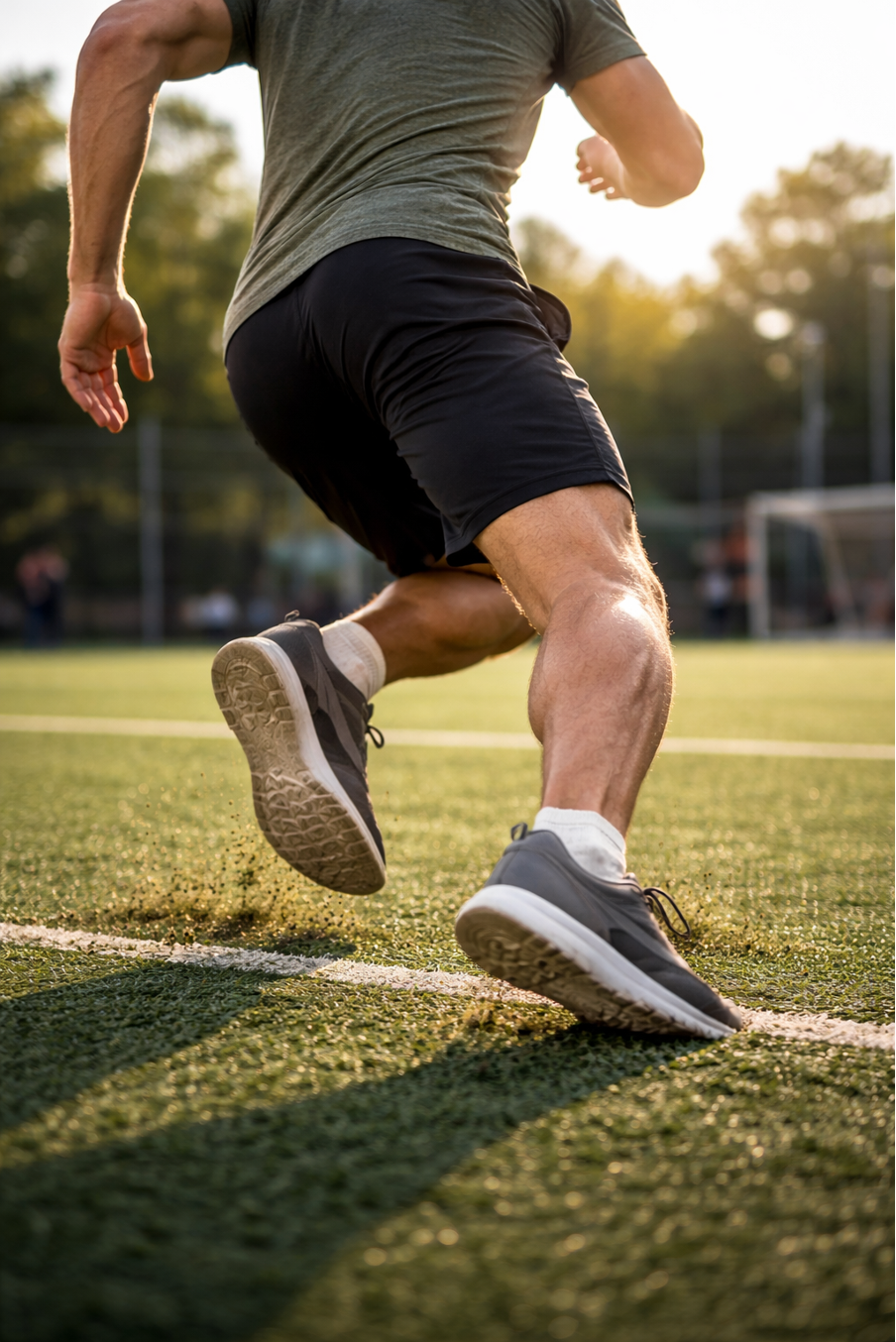
In sport, the ankle is a key performance joint. It is the final link in the kinetic chain and the primary point of force transfer between the body and the ground. For sprinting, jumping, cutting and landing, a stable ankle allows forces generated at the hip and knee to be stored, controlled and released efficiently.
When ankle stability is compromised, performance output declines. Research consistently shows that athletes with reduced ankle stability demonstrate:
- Lower push-off forces and reduced rate of force development
- Decreased jump height and reactive strength
- Slower sprint acceleration and impaired change-of-direction ability
- Delayed peroneal muscle activation and poorer joint position sense
Chronic ankle instability disrupts neuromuscular control and alters movement strategies under high load. Athletes often subconsciously “protect” the ankle, resulting in reduced stiffness at ground contact, energy leaks through the foot-ankle complex and inefficient force transfer. Over time, this not only increases re-injury risk but also limits maximal and repeatable performance.
Targeted rehabilitation that includes strength, plyometric control, balance and sport-specific loading has been shown to restore ankle stiffness, improve force transmission and enhance performance measures such as jump efficiency, agility and running economy.
Evidence-based rehabilitation typically includes:
- Range of motion exercises
Restoring ankle dorsiflexion is associated with improved movement efficiency and reduced reinjury risk. - Balance and proprioceptive training
Proven to significantly reduce recurrent ankle sprains and improve postural control in people with CAI. - Strengthening exercises
Targeting the calf, peroneals, tibialis posterior and intrinsic foot muscles improves dynamic ankle support and load tolerance. - Functional and sport-specific training
Task-specific loading improves confidence, movement quality and return-to-activity outcomes. - Injury prevention strategies
Bracing or taping during higher-risk activities has strong evidence for reducing recurrence, especially in sport.
If you have a niggly injury that you can't shake, book an appointment today with Eike today. Call (02) 4268 4884, or click below to book online.